
Guide · Filter media
How to select the right filter medium
A structured decision path: which criteria determine the filter medium — and in which order you should check them.
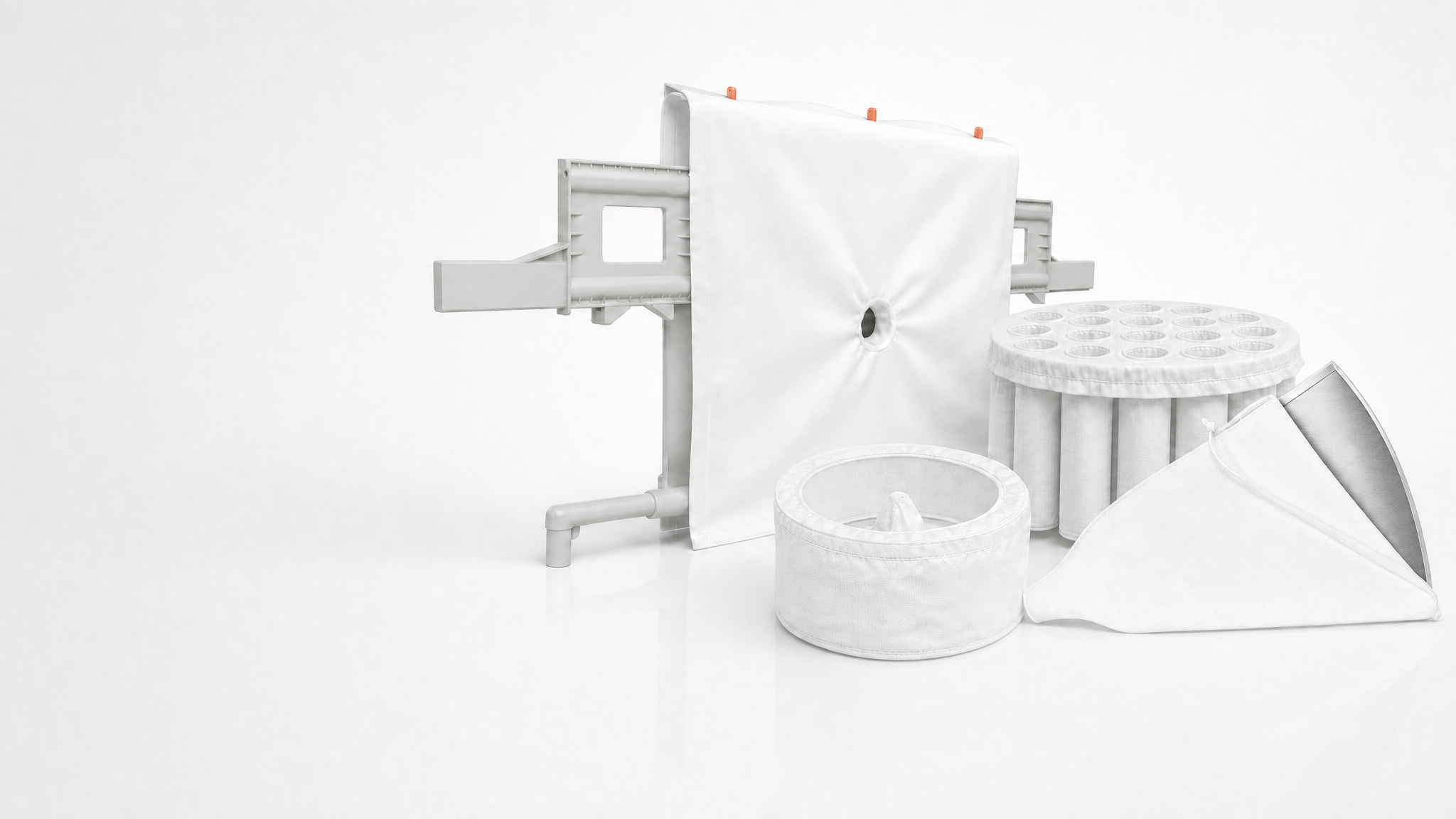
Choosing a filter medium by filtration grade alone rarely works. The right medium is the one that withstands your process conditions, separates the particles you need to remove and stays permeable long enough. This guide sets out the criteria we check in every project — in a sensible order.
The decision path in 12 criteria
Work through them from top to bottom — early criteria exclude materials, later ones refine the structure.
Medium to be filtered
Liquid or gas, viscosity, and whether it is aqueous, solvent-based or a suspension.
Temperature
Continuous and peak temperature — often the first criterion that excludes materials.
Chemical compatibility
pH range, oxidising agents, solvents and hydrolysis risk at elevated temperature.
Particle size
Size distribution of the particles to be separated — defines the required filtration grade.
Solids concentration
Low loads favour depth filtration; high loads favour surface filtration with cake formation.
Flow rate
Determines the required filter area and the permeability of the medium.
Pressure & differential pressure
Mechanical strength of the medium and the permissible pressure drop in the system.
Required filtrate quality
How clean the filtrate has to be — and how it is measured.
Cleaning concept
Backwashing, cake discharge, cleaning in place — or replacement of the element.
Cake release
Where a filter cake forms, the surface of the medium determines how well it releases.
Installation space
Available space and element geometry limit filter area and construction.
Continuous or batch
Continuous processes need stable long-term permeability; batch processes need reliable regeneration.
Common filter materials at a glance
The polymer sets the framework for temperature and chemical resistance. The table gives a general orientation only — the actual suitability always depends on the specific grade, construction and operating conditions.
| Material | General characteristics | Typical points to check |
|---|---|---|
| PP (polypropylene) | Good resistance to many acids and alkalis, low density | Limited temperature range; oxidising agents |
| PET (polyester) | Good mechanical strength, higher temperature range than PP | Hydrolysis in hot alkaline or hot aqueous media |
| PA (polyamide) | High abrasion resistance and toughness | Sensitive to acids; moisture absorption |
| PTFE | Very broad chemical resistance, high temperature range | Cost; mechanical support often required |
| PEEK | High temperature and chemical resistance, mechanically strong | Cost; used for demanding applications |
| PPS | High temperature range, good resistance to acids and alkalis | Sensitive to strong oxidising agents |
| Aramid | High temperature range, good mechanical strength | Hydrolysis and chemical attack depending on conditions |
General orientation without guaranteed values. We check suitability for your specific conditions.
Structure matters as much as material
The same polymer can be processed into very different media: woven fabrics with defined openings for cake filtration, nonwovens and needle felts for depth filtration, membranes for very fine separation or pile structures for specific applications such as pile cloth media filtration. Fibre fineness, density, thickness and surface finish determine separation behaviour, permeability and cleanability.
When the standard medium is not enough
If no available medium meets all criteria, a custom-developed filter medium can be the solution — especially for OEMs and new processes. The in-depth range of filter fabrics is presented on our specialist site filter-fabrics.eu.
Frequently asked questions
Which criterion should I check first?
Temperature and chemical compatibility. They exclude unsuitable materials before you start optimising filtration grade and structure.
Is a finer medium always better?
No. A finer medium than necessary increases differential pressure and can shorten service life. The filtration grade should match the particles that really have to be removed.
Surface or depth filtration — what is the difference?
Surface filtration retains particles on the surface, often forming a filter cake that can be removed. Depth filtration retains particles within the medium and is typically used for low solids loads.
Can you help if we are unsure?
Yes. Describe your process in the engineering assessment and we will propose a suitable medium or a development path.
Not sure which medium fits?
Describe your process in the engineering assessment — we check the criteria for you.