
Problem → Solution
Hot process, deforming filter plates — filtration at elevated temperature
When filter plates warp, crack or lose tightness in hot processes, the plate material is operating outside its window. We match material and design to your process temperature.
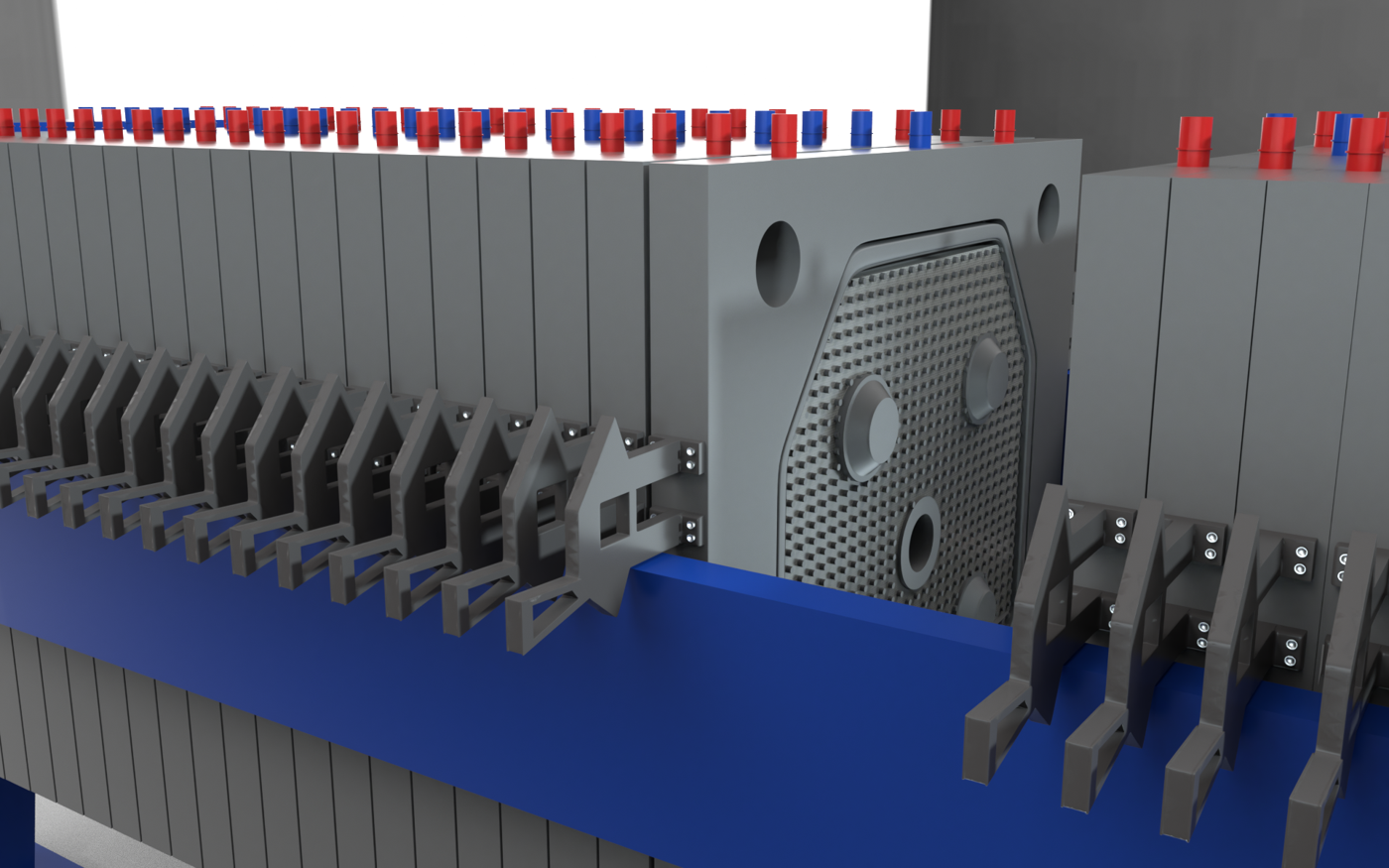
Many solid/liquid separation processes run hot — because the product is processed warm, because viscosity drops with temperature, or because cooling is not economical. Standard polypropylene plates are designed for moderate temperatures. Above their window they can deform, lose sealing tightness or age prematurely. The solution starts with knowing the real temperature profile of the process.
Typical signs
Filter plates warp or bend after a period of operation.
Cracks appear at the plate edges, ports or support area.
The press becomes leaky as process temperature rises.
Plates have to be replaced noticeably earlier than in cold applications.
Process temperature has increased since the press was designed.
From problem to product
We do not start with the product; we start with the cause.
Plates deform or crack
Warping, cracks, loss of tightness or shortened plate life in hot processes.
Material outside its temperature window
Plate material not designed for the process temperature, temperature peaks, or combined thermal and pressure load.
Match plate material to temperature
Define the real temperature profile and select a plate material designed for it.
High-temperature plate design
Plates from specially formulated high-density polypropylene for elevated process temperatures.
Plate, cloth and seal
Not only the plate: filter cloth and seal elastomer must also suit the temperature.
High-temperature filter plates
High-temperature filter plates for operating temperatures up to 120 °C.
How we approach it
Real temperature profile
Continuous temperature, peaks and cleaning temperatures — not just the nominal value.
Combined loads
Temperature, filtration pressure and chemistry act together on the plate.
Whole system
Plate, filter cloth and seal are selected for the same temperature window.
Why filter plates fail in hot processes — and what helps
Plastics lose stiffness as temperature rises. A filter plate that works reliably at ambient temperature can deform under filtration pressure when the process runs hotter than its design window. Deformation leads to leaks at the sealing faces, uneven chambers and, in the worst case, cracks.
Temperature peaks are often underestimated: hot cleaning cycles, start-up phases or process upsets can exceed the normal operating temperature. The plate material must be selected for the real profile, including these peaks, and in combination with the filtration pressure and the chemistry of the medium.
R+F high-temperature filter plates are made from specially formulated high-density polypropylene for operating temperatures up to 120 °C. We also check that filter cloth and seals suit the same temperature window — otherwise they become the weak point.
The product: high-temperature filter plates
Filter plates from specially formulated high-density polypropylene for operating temperatures up to 120 °C — in the dimensions of your filter press.
Frequently asked questions
Up to which temperature can R+F high-temperature plates be used?
R+F high-temperature filter plates are designed for operating temperatures up to 120 °C.
Why do my plates deform although the temperature is within the range?
Temperature acts together with filtration pressure and chemistry. Temperature peaks, for example during hot cleaning, can also exceed the nominal value.
Do the filter cloths also need to be adapted?
Yes. Filter cloth and seal elastomer must suit the same temperature window as the plate.
Tell us about your filtration problem
A short, guided assessment is enough — it goes straight to our engineering team, free and without obligation.