
Guide · Materials
Filter materials overview — polymers, elastomers and plate materials
Which material for which process? An orientation on temperature range and chemical resistance of common filtration materials — from the filter medium to the seal.
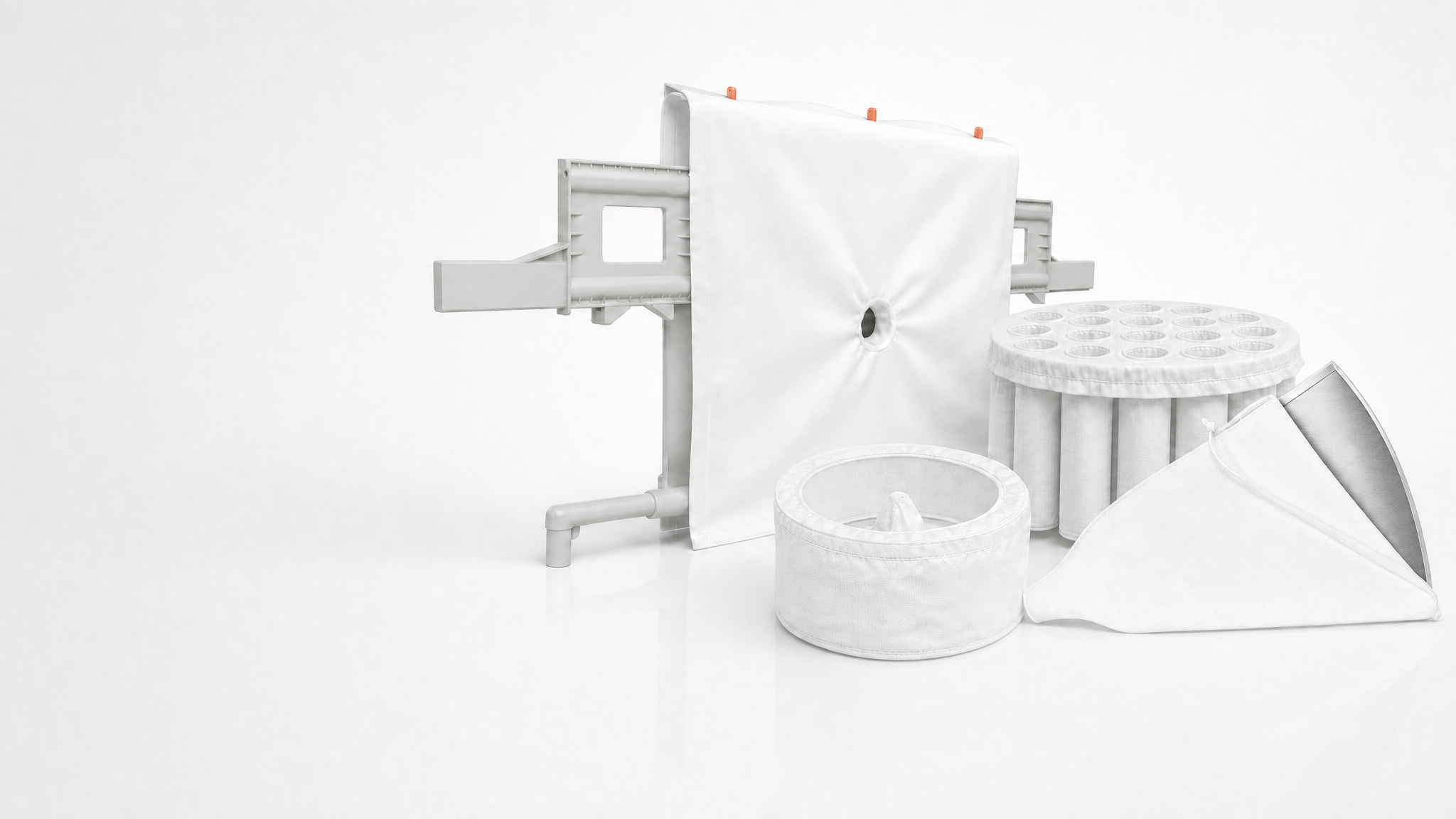
The material decides whether a filter element survives in your process. Temperature and chemistry exclude materials before filtration grade and structure even come into play — and not only for the filter medium, but for every component: support, end caps, bonding, seals and, in filter presses, the filter plates. This overview gives a structured orientation. It does not replace a check of your specific conditions.
How to use this overview
Check the components of your filter in this order.
Define the operating window
Medium, concentration, continuous and peak temperature, cleaning agents.
Pre-select the filter medium
Use the polymer table to exclude unsuitable materials.
Check the seals
The elastomer is often the first component to fail.
Check construction materials
Core, end caps, bonding — and plates in filter presses.
Validate
Where data is not conclusive: test samples in the real medium.
Polymers for filter media — orientation
The table compares common polymers for filter fabrics, nonwovens and membranes. Ratings are relative and general: ++ very good, + good, o limited, – unsuitable. Concentration, temperature and exposure time can change the rating considerably.
| Material | Temperature range | Acids | Alkalis | Solvents | Oxidising agents |
|---|---|---|---|---|---|
| PP (polypropylene) | moderate | ++ | ++ | o | o |
| PE (polyethylene) | moderate | ++ | ++ | o | o |
| PET (polyester) | medium | + | – | + | + |
| PA (polyamide) | medium | – | + | + | – |
| PVDF | high | ++ | o | + | ++ |
| PPS | high | ++ | ++ | ++ | o |
| PTFE | very high | ++ | ++ | ++ | ++ |
| Glass fibre | very high | + | – | ++ | + |
General orientation without guaranteed values. Polyester is additionally sensitive to hydrolysis in hot aqueous media. We check suitability for your specific conditions.
Elastomers for seals
Seals are frequently overlooked — and frequently the weakest point. The same elastomers are used for filter element O-rings and for the O-ring sealing of CGR filter plates.
| Elastomer | Generally suitable for | Generally unsuitable for |
|---|---|---|
| NBR (nitrile) | Aliphatic hydrocarbons, water, many dilute acids and alkalis | Ketones, ozone and weathering, strong oxidising agents |
| EPDM | Water, steam, alkalis, many polar media and ketones | Hydrocarbons and many solvents |
| FKM (e.g. Viton) | Many acids, hydrocarbons and solvents, elevated temperatures | Ketones, amines, hot alkalis |
Orientation only. Concentration and temperature determine actual suitability.
Filter plate materials
Filter plates for chamber filter presses are usually made from polypropylene, which is resistant to many aqueous, acidic and alkaline suspensions. For hot processes, R+F supplies high-temperature filter plates from specially formulated high-density polypropylene for operating temperatures up to 120 °C. For special applications, round plates and plates from phosphor bronze are available.
- Standard and high-pressure plates: polypropylene.
- Hot processes: high-temperature plates from specially formulated high-density polypropylene, up to 120 °C.
- Leak-critical applications: CGR plates with O-ring sealing in nitrile, EPDM or Viton.
The element is more than its medium
A filter element combines several materials: filter medium, support and drainage layers, core, end caps, adhesive or welding and seals. Every one of them must suit the medium and temperature. A highly resistant medium in an element with an unsuitable adhesive or seal will fail at the weakest component. For custom elements, we select the complete material concept together with you.
Three rules of thumb
Temperature first
It is usually the first criterion that excludes materials.
Include cleaning
Cleaning agents and temperatures often stress materials more than production does.
Weakest component
The least resistant material in the element determines its service life.
Frequently asked questions
Why does the table not show exact temperature values?
Permissible temperatures depend on the specific grade, construction, mechanical load and chemistry. Single figures would suggest a precision that general tables cannot provide. We check the values for your conditions.
Is PTFE always the best choice?
PTFE has the broadest chemical resistance, but it is more expensive and mechanically different. Often PP, PVDF or PPS is the more economical and equally suitable option.
Which seal material should I choose?
It depends on medium and temperature. NBR, EPDM and FKM each have clear strengths and weaknesses — the medium decides.
Unsure which material suits your process?
Describe medium, temperature and chemistry in the engineering assessment — we propose a suitable material concept.